Guide 01
The Item Reduction
Guide
A structured, two-hour process to audit your kitchen, identify what belongs, and permanently remove everything that doesn't. Follow each step in sequence. Don't skip ahead.
Before You Begin
Prepare Yourself
and Your Space
What to Prepare
Clear a large surface — a dining table or floor area — where you can lay out all kitchen items. Have boxes or bags ready for donations and discards. Keep a permanent marker and labels on hand.
The Right Mindset
Approach this as an audit, not a purge. You are gathering information about what you actually own and use. Decisions made with accurate information are better decisions. Reserve judgement until the audit is complete.
Time Required
Allow two uninterrupted hours for an average kitchen. Larger kitchens or very cluttered kitchens may require three. Do this alone or with a willing partner — not with someone who will resist the process.
The Process
Five Steps to a
Minimal Kitchen
The Complete Audit
Remove every single item from every drawer, cabinet, shelf, and counter. Lay everything out on your designated surface. This is not optional — partial audits produce partial results. You need to see the full volume of what you own before you can make rational decisions about any of it.
- Empty every drawer completely
- Remove all items from every cabinet
- Clear all countertop items
- Include items stored in other rooms (garage, utility room)
The Usage Test
For each item, ask one question: Was this item used in the last 30 days? If yes, set it aside in a "keep" pile. If no, do not discard it yet — simply move it to a "review" pile. The review pile will be examined in steps three and four.
- Used in last 30 days → Keep pile
- Not used in last 30 days → Review pile
- Be honest — "I might use it soon" does not count as used
- Seasonal items get a pass if their season was more than 30 days ago
The Duplication Check
Look at both piles. Do you have two or more items that serve the same or highly similar function? A whisk and a fork can both beat eggs. Two cutting boards of the same size serve the same purpose. Wherever duplication exists, keep only the best version and add the rest to the remove pile.
- Compare spatulas, spoons, ladles — keep the best, remove the duplicates
- Check for duplicate pan sizes
- Review measuring cups and spoons — one set is sufficient
- Multiple can openers, peelers, scissors — reduce to one of each
The Versatility Assessment
For every item remaining in the review pile, ask: does this item do only one thing? Could an item already in the keep pile perform this function? A garlic press can be replaced by a knife. An avocado slicer does only one thing a knife cannot. Single-function items that are rarely used are strong candidates for removal.
- Garlic press → Chef's knife performs this function
- Apple corer → Chef's knife performs this function
- Egg separator → hands perform this function
- Strawberry huller → paring knife performs this function
The Permanent Edit
Everything not in the keep pile now receives a final decision: donate, discard, or store off-site. Items in good condition go to donation. Items that are broken or worn go to recycling or waste. Items with genuine seasonal or sentimental value go into labelled off-site storage — not back into the kitchen.
- Good condition, not needed → Donate to local charity or food bank
- Broken or heavily worn → Discard responsibly
- Seasonal (Christmas, Passover, etc.) → Labelled box, off-site storage
- Gifts with sentimental value → Off-site storage, not the kitchen
The Result
What Remains
Belongs
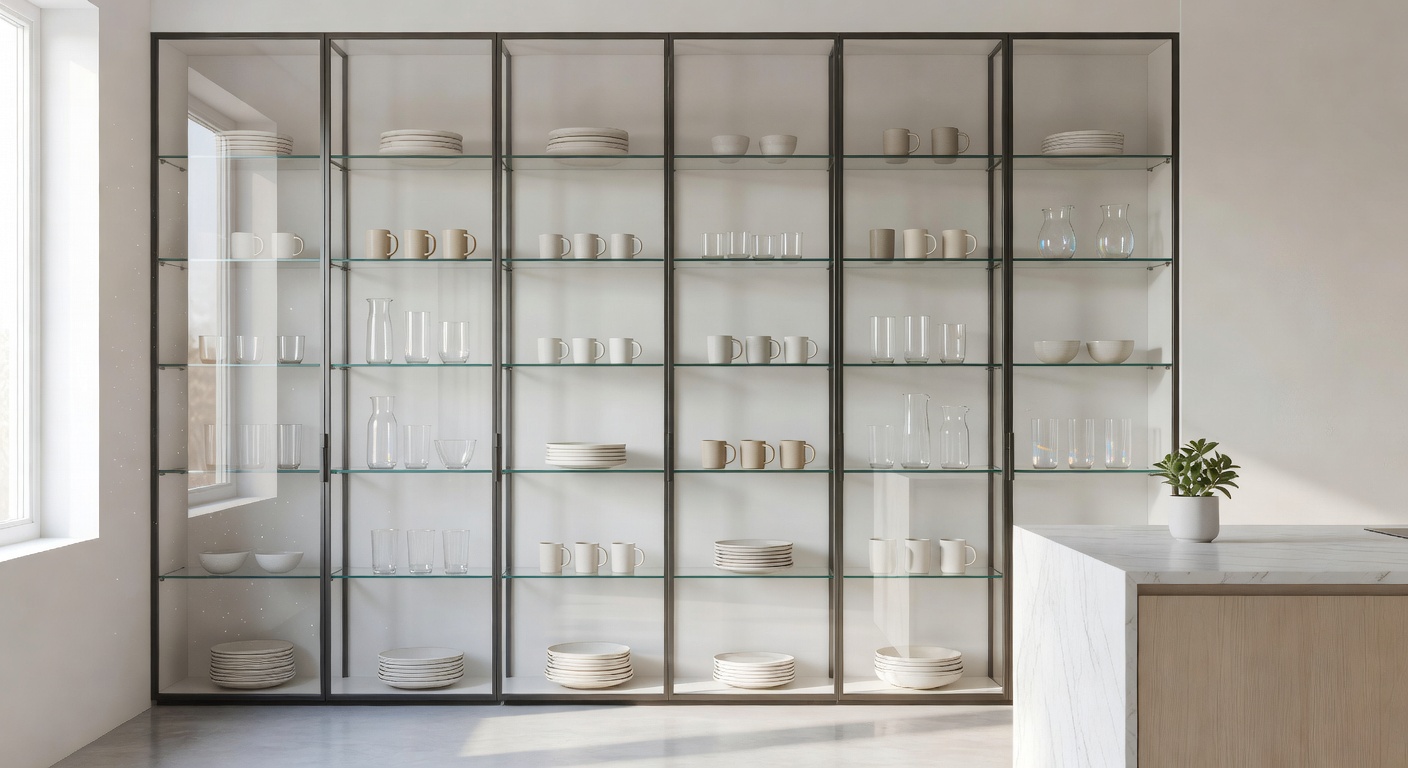
After the audit, every item in your kitchen is there because it was used recently, it has no adequate substitute, and it performs a function that justifies its presence. This is the foundation of the minimal kitchen.
The first time you open a drawer after the reduction, you will understand what the system is for. Everything visible. Everything accessible. Nothing hidden behind something else.
Category Guidance
Advice by
Category
Each category of kitchen item has its own logic for what to keep and what to remove. Expand each section for specific guidance.
Utensils
The average kitchen contains three times as many utensils as it needs. The essential set: one large wooden spoon, one silicone spatula, one pair of tongs, one ladle, one whisk. Everything else is either a duplicate or a single-purpose item that a knife can replace.
- Keep: wooden spoon, silicone spatula, tongs, ladle, whisk
- Remove: multiple spatulas of the same type, garlic press, cherry pitter
- Remove: avocado slicer, egg separator, strawberry huller
- Keep one: can opener, peeler, grater/microplane, kitchen scissors
Appliances
Appliances are the largest consumers of counter and cabinet space, and also the most emotionally charged. Each appliance must be evaluated against three criteria: frequency of use (at least twice weekly), function uniqueness (nothing else can replace it), and size justification (the footprint is worth the function).
- Keep: oven/stove, refrigerator, kettle, blender
- Keep if used 3+ times weekly: toaster, coffee machine
- Consider removing: air fryer, bread maker, juicer, egg cooker
- Remove: waffle iron, fondue set, sandwich press, pasta machine (if unused)
Cookware
A complete cookware set covers every cooking method with five to six pieces. The cast iron pan handles searing, frying, and oven work. The saucepan handles boiling, sauces, and reheating. The sheet pan handles roasting. Anything beyond this is duplication.
- Keep: 10-inch cast iron pan, 2L saucepan, sheet pan, large pot for pasta
- Keep if used regularly: non-stick pan for eggs, Dutch oven
- Remove: multiple pans of the same size, speciality pots
- Remove: wok (unless you cook Asian food weekly), crepe pan, griddle
Pantry Items
Pantry reduction follows a different logic from tools. The primary tests are: expiry date, frequency of use, and redundancy of function. Spices degrade after 18 months. Oils go rancid. Specialty ingredients bought for one recipe and never used again are pantry clutter.
- Check every expiry date — discard anything past date
- Consolidate: three types of vinegar becomes one (red wine vinegar)
- Remove specialty items used less than once every two months
- Reduce spice collection to 12–15 core spices you actually use
The Organised Result
Open Shelving as
an Accountability Tool
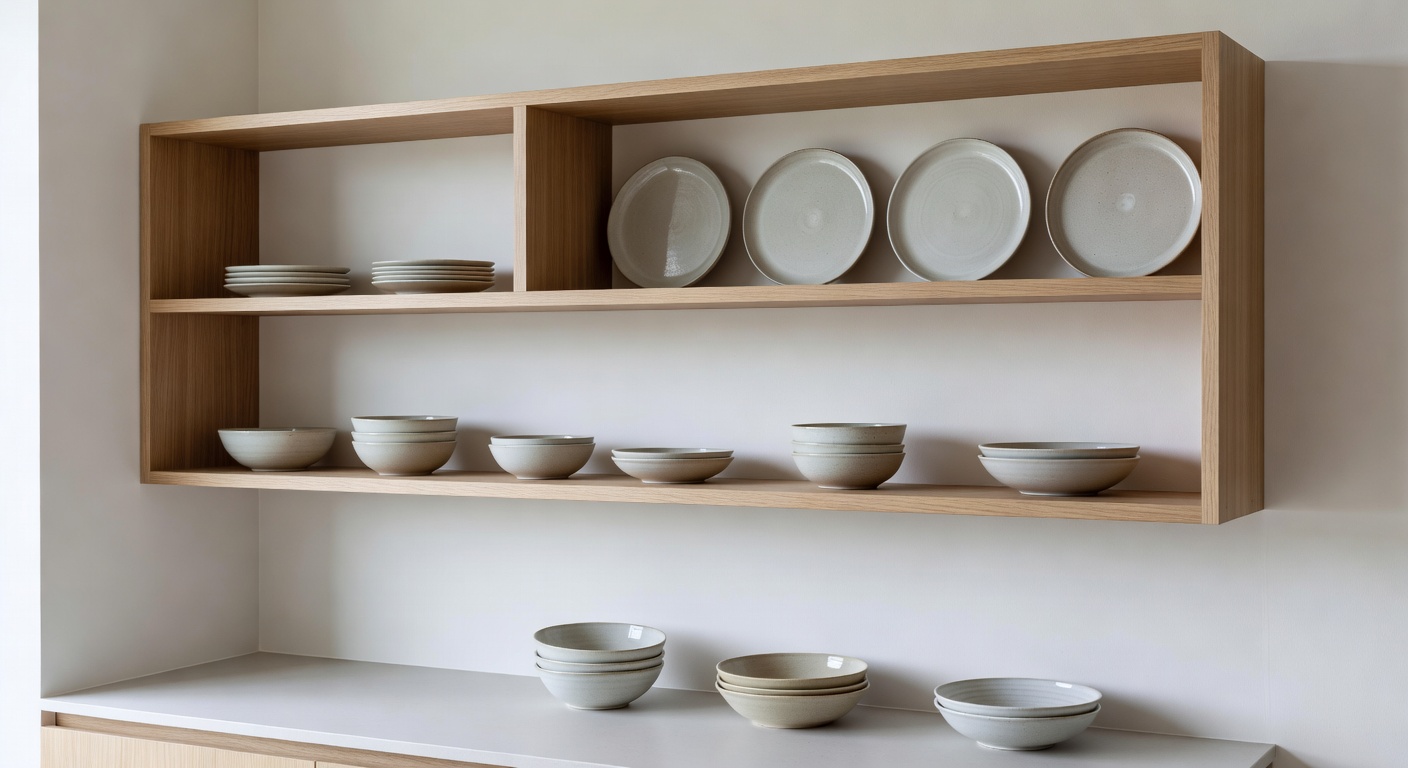
Open shelving makes reduction permanent. When items are visible, you are naturally more selective about what earns shelf space. Ceramics and regularly used items become a considered, minimal display — not a storage solution for overflow.
The test: if you wouldn't display it on an open shelf, it shouldn't be in your kitchen at all.
Get the Checklist
Download the
Reduction Checklist
A printable, category-by-category checklist to use during your kitchen audit. Room by room. Item by item.