Philosophy
Declutter the Logic,
Not Just the Space
Essential-Only Thinking
Keep What Is Used.
Release the Rest.
The core principle of RIA philosophy is simple: if you have not used an item in the last seven days, its presence in your kitchen must be questioned. Not condemned — questioned. For most items, the honest answer is that they are not needed and have never been needed.
Essential-only thinking is not about deprivation. It is about precision. A kitchen that contains only what you use is a kitchen that functions without friction. Every drawer opens to exactly what you need. Every cabinet holds exactly what you use. Nothing hides behind something else.
The one-week rule is a heuristic, not a law. A bread-proofing basket might be used only on weekends. A large roasting pan might be used only monthly. The test is whether an item's use justifies the space and cognitive overhead it occupies. Usually, the answer is no.
The Hidden Cost
The Weight of
Unused Objects
Cognitive Load
Every object in your environment makes a claim on your attention, however small. A kitchen crowded with unused items is a kitchen that asks you to manage its inventory every time you enter it. The mental cost compounds over time into something that feels like fatigue without a clear cause.
Decision Fatigue
When a kitchen contains forty tools, each cooking task begins with a small decision: which pan, which utensil, which vessel. These decisions are individually trivial but collectively exhausting. A kitchen with twelve tools eliminates nearly all of them. You simply reach for what you need.
Visual Noise
Cluttered surfaces are not neutral. Research in environmental psychology consistently finds that visual complexity increases stress hormone levels and reduces the sense of calm associated with home environments. A clear counter is not an aesthetic preference — it is a psychological one.
Six Principles
The Principles That
Guide Every Decision
These six principles form the philosophical backbone of the Rare Island Animals. Apply them consistently and the kitchen maintains itself.
The 1-Week Rule
If an item has not been used in the past seven days, its place in the kitchen must be actively justified. Items that cannot justify their place are candidates for removal.
One In, One Out
Every new item entering the kitchen must displace an existing one. This creates a permanent ceiling on volume and forces deliberate decision-making before any acquisition.
Surface-Zero Rule
Counter surfaces default to empty. Only items used at least three times per week may live on the counter. Everything else belongs in a drawer, cabinet, or elsewhere.
The Versatility Test
Does this item do only one thing? Could another item already in the kitchen perform the same function adequately? If yes to both, it is a candidate for removal.
Emotional Audit
Some items are kept from guilt, sentimentality, or vague future intention. These are the hardest to remove and the most important. An emotional audit surfaces what logic doesn't.
The Reset Ritual
A weekly five-minute reset — surfaces cleared, items returned, nothing out of place — is what keeps the system alive. Without it, entropy returns, slowly but certainly.
Waste as Philosophy
Waste Reduction
Begins with Reduction
The minimal kitchen produces less waste — not because its owner is more disciplined, but because the system itself prevents over-purchasing, over-stocking, and over-owning. A pantry with forty curated items gets used. A pantry with two hundred items generates waste.
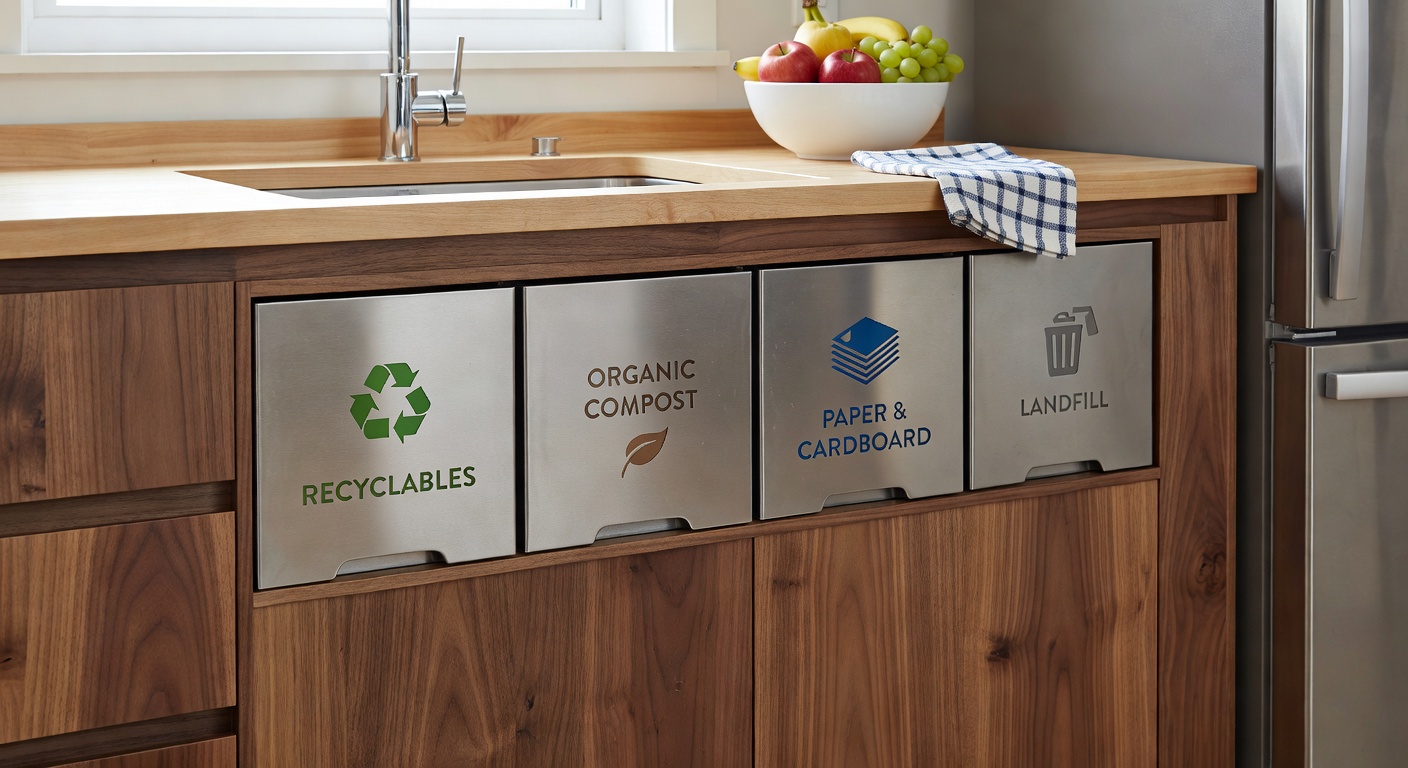
Integrated recycling and composting are not afterthoughts in the RIA approach. They are designed into the cleaning zone from the start. A hidden, accessible system removes the friction that causes waste to pile on counters.
The Minimal Sink
The Cleaning Zone
Kept Honest
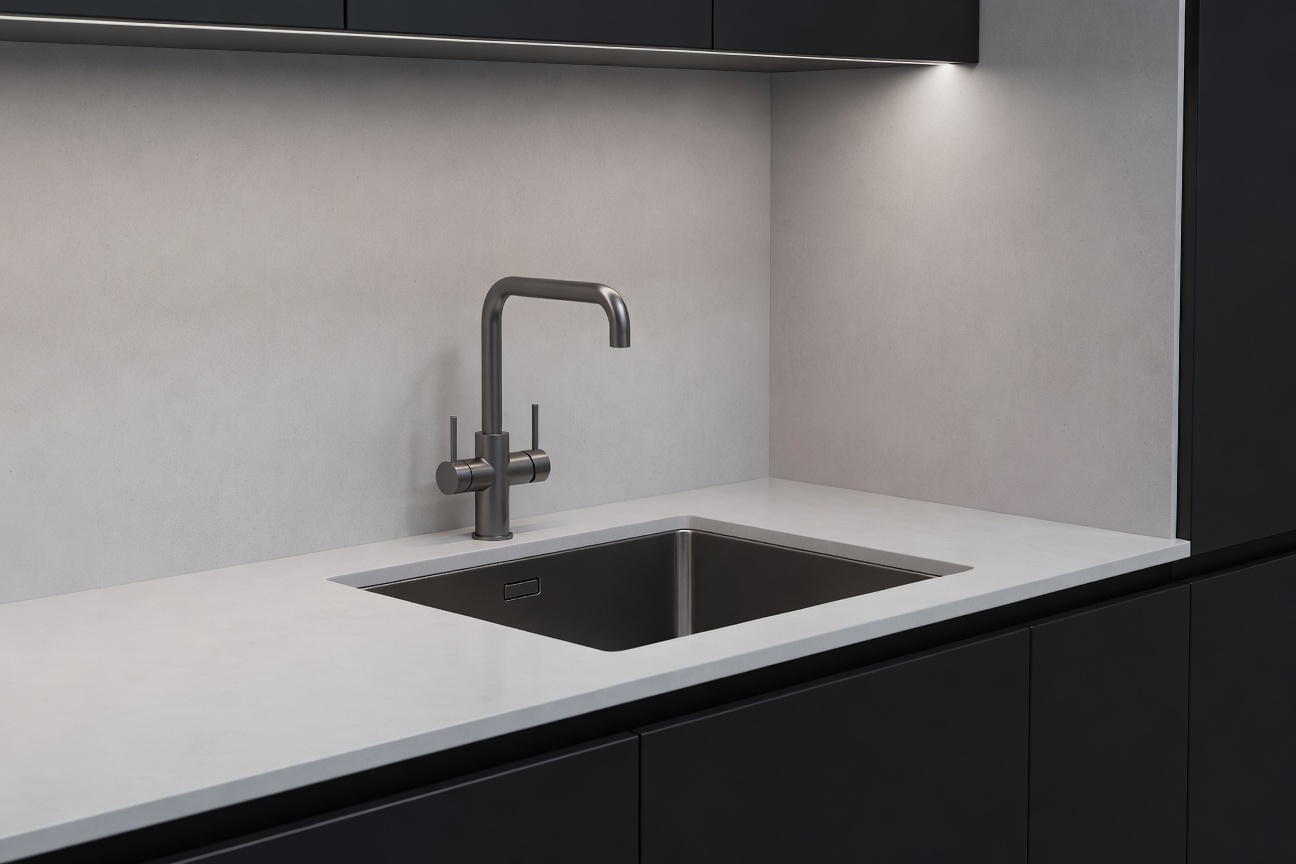
The sink area is where the minimal kitchen is most easily compromised. Dish soap, sponges, brushes, drying racks — each item introduced must earn its presence. The minimal sink setup contains only what is used in every wash: one soap dispenser, one brush, one cloth.
A dish rack that lives permanently on the counter is a counter permanently occupied. The alternative — washing and putting away in a single motion — takes no more time and returns the surface to zero every time.